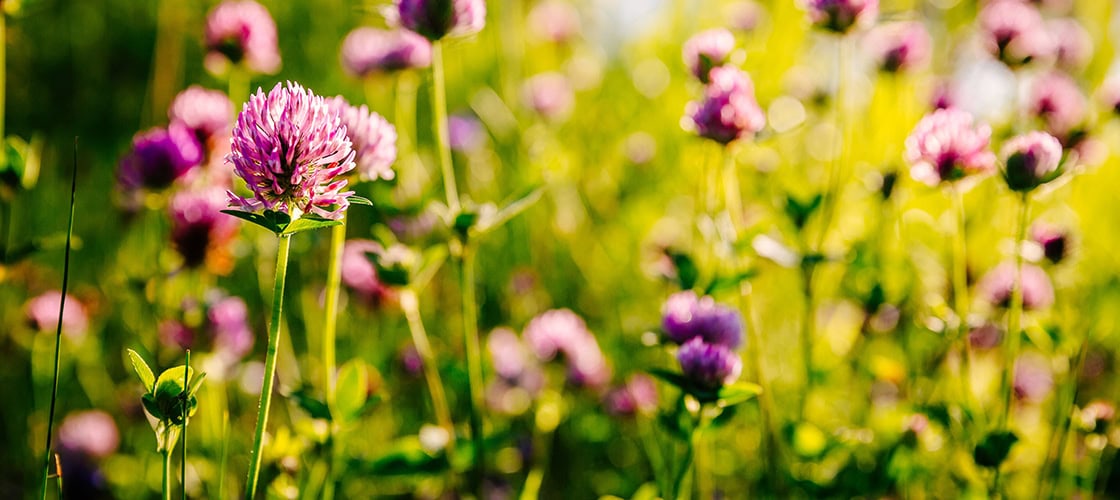
When Sinead O Keeffe went looking for ingredients to formulate her new skincare range, she couldn’t source a single one from Ireland. Everything, including red clover flowers (a plant that grows freely across the country), ships in from abroad. That realisation was the seed that Sinead’s new startup grew from. Bioclover is Ireland’s first farm-to-lab cosmetic ingredients company.
Sinead has spent her entire working life in the beauty industry, accumulating expertise across everything from salon management to cosmetic chemistry to regulatory compliance consultancy for major international brands. Bioclover is based on her farm in Mallow, Co. Cork, where she and her husband are growing the plants for a new range of innovative bioactive ingredients. CloverCell®, the company’s first product, is now available. We talked to Sinead about the journey.
You’ve been in the beauty industry since you were 17. How did you go from working in salons to working on a farm?
 It feels like everything has led me to where I am now. I started off doing makeup, and brows and lashes, then managed my sister’s salon for years. After that I went to Asia and trained in advanced skincare techniques like needling and dermaplaning. My Korean teacher was getting her training manuals accredited in Ireland and the UK, so I started working on the health and safety and regulatory side of that for her.
I kept going down that road. I went on to study Cosmetic Chemistry, did a Diploma in Formulation, and set up a beauty training company for salons called Tiger Academy. I had a professional brow brand too – bringing in products and offering training alongside them. I learned a lot about ingredients and formulations through all of that and was thinking of starting a skincare company.
I went looking for the ingredients I needed and realised that Ireland imports all of them. You couldn’t even source products made from native Irish flowers. So, I started making my own plant and flower extracts at home. But I thought, why do we import everything, especially given our international reputation for farming?
You started the New Frontiers programme with the skincare brand idea. What made you pivot?
I joined the Exxcell programme and then Phase 1 of New Frontiers at the Rubicon Centre in Cork. Though the idea was originally a skincare brand, I kept coming back to the ingredients question during research. I was doing some regulatory compliance consultancy work on the side for some big brands, and they had the exact same issue. There are only 60 major ingredient producers in the world, and none are in Ireland. Everyone was importing. That’s a big opportunity, and the sustainability angle makes it more so. I thought about what it would take to launch a cosmetics company and how much B2C marketing would be needed in such a tough, competitive industry.
So, I pitched the B2B angle to one of my mentors and he thought it was a very strong idea. I had sent some samples to the Centre for Applied Bioscience Research (CABR) who I was working with on the skincare brand. The data that came back was really significant – clinical studies showed the extract was protecting and repairing the skin barrier and reducing inflammation. When I saw those results, I decided. I patented the extraction process (patent pending) and it went from there. I got onto Phase 2 and continued building the business. New Frontiers was amazing. I’ve a peer group that’s unbelievable and we all support each other.
Tell us about the plants you are focusing on at the moment and the products you are making.
CloverCell® is the first, extracted from red clover grown on the farm. The second ingredient product will be gorse-based, and after that, nettles. What I find fascinating is that these are plants people discard. Weeds. Many cosmetic ingredients start with plants but are created through biotechnology. Hyaluronic acid, for example, is produced through fermentation using plant-derived sugars such as wheat or corn. The beginning is always nature.
Big brands find it genuinely difficult to be sustainable at scale because their supply chains are too global and too complex. But an Irish producer like Bioclover can offer them something they actually can’t easily get elsewhere: traceability, organic practices, and a circular economy model. The waste from our production isn’t waste – the clover flowers will become compost and go back into the soil to grow the next crop. We’re also on a two-year conversion to organic certification.
How hard was the science behind these transformations?
Harder than I anticipated. I thought the lab work would take three months; it took six. Because we’re dealing with plants, you can’t fully control the process. For example, in our first tests the extract was behaving like a fermented ingredient, and we had to control the yeasts that are naturally present. That meant going back to the lab several times, setting up new protocols, tightening the measures. There were things I’d never thought about before that required deep research. The compliance certificates took longer than expected too. But recently we passed everything – including microbial testing and heavy metal testing – and we sent our first sample to a client. They were delighted.
What are your plans for Bioclover in the short and longer terms?
Now our first product, CloverCell®, is available, the next 12 months are focused on production. We’re setting up new polytunnels with a growing area and a drying area. We’ll be the first farm to grow nettles deliberately! I’m building an office and we need a storage facility as well. It all needs investment, so I’m looking at PSSF as well.
When you sell to a lab, you make the ingredient and send it to them, but then they have to run stability testing over 12 weeks before they’ll place an order. So, the gap between a sale and revenue is long. It’s hard going financially. This year the focus is on Irish labs, for the smaller cosmetic brands that manufacture in-house, with a view to selling to the UK next year.
Long term, the plan is acquisition. Because there are only 60 major producers in the world, what typically happens is that when a small company comes along with a genuine breakthrough, they get bought within a few years. Sometimes the founder stays on in the acquiring company, sometimes not. But that’s the end plan.
If you went back and did it all again, is there anything you would do differently?
It’s hard to say. I might have started the regulatory side earlier because that’s where a lot of time was lost. And I might not have started with the skincare brand at all and gone straight into producing ingredients. But then each step leads to the next, doesn’t it? I think my whole life has led me to this point. From the salon, to Asia, to the chemistry, to the regulation, to the farm. It all connects.
Sinead was a participant of New Frontiers in Cork (Munster Technological University (MTU) – Cork Campus) where our Programme Manager is Aoife McInerney. Learn more about Sinead’s company at bioclover.com.
About the author
 Scarlet Bierman
 Scarlet Bierman
Scarlet Bierman is a content consultant, commissioned by Enterprise Ireland to fulfil the role of Editor of the New Frontiers website. She is an expert in designing and executing ethical marketing strategies and passionate about helping businesses to develop a quality online presence.
Recent articles
A Cohort Of Ambitious Entrepreneurs Graduates From New Frontiers In The Midwest
Meet The Latest Cohort To Graduate From New Frontiers In Blanchardstown
New Frontiers Graduates Are Celebrated At A Showcase Event In Kerry
Ten Founders Graduate From The New Frontiers Programme In The Northwest
After 20 Years In Compliance, Fiona Finucane Is Helping SMEs Get Ready For New AML Rules

The Beginning Is Always Nature: Sinead O Keeffe On Producing Ireland’s First Cosmetic Active
Founders Graduate From New Frontiers At South East Technological University – Carlow Campus