Building a sustainable business means solving two problems at once: the environmental issue you’re tackling, and the commercial reality of making it work. We spoke to three founders about the challenges that shaped their businesses, how they balance making money with their environmental commitments, their approach to changing customer behaviour, and where they see the sector heading.
The founders are Meg Brennan of Polliknow (technology to measure biodiversity data at scale), Paul McGoldrick of Slíglas (producing high quality biochar to lock away carbon for millennia), and Shana Chu of Tailr (combating inconsistent sizing and garment waste in the fashion industry).
Question 1: What was the biggest challenge you faced in launching and growing your sustainable business, and how did you overcome it?
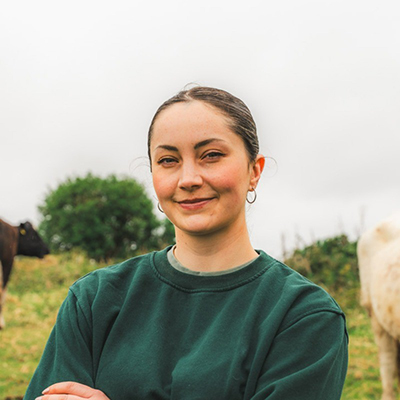
Meg Brennan of Polliknow
Meg: The biggest challenge has been balancing technical development with commercial traction in a completely new market category. Biodiversity monitoring is an emerging area, more regulation is coming in and consumers are putting pressure on big brands to restore and improve nature. This field has always relied on manual surveys so we’re building something that needs to work alongside those traditional methods while pushing the industry forward. It’s a completely evolving space which is exciting but also means we’re constantly adapting. We’ve overcome this by running trials across different habitats and with different types of customers, from small to large rewilding projects. These early partnerships have been invaluable for refining our technology and understanding what the market actually needs.
Paul: Launching a sustainable business focused on biochar generation for carbon dioxide removal requires significant investment to conduct R&D and progress through to production readiness. Slíglas has managed to minimise prototyping costs by simulating reactor performance to refine design and approach. A second challenge has been establishing trust and transparency. Pursing pre-certification and putting in place a plan to meet the rigorous standards required of a CDR business has resulted in strong credibility.
Shana: One of the biggest challenges was reframing how the industry thinks about sustainability. Most people immediately jump to materials, recycling or consumer behaviour. But the environmental cost of inconsistent fabric performance is enormous, every mis-cut garment, failed sample and avoidable return has a material, energy and labour footprint. Convincing brands that sustainability starts with stability was not simple. We overcame this by proving it with data. Once we could demonstrate, at fabric-batch level, how shrinkage, stretch, and colour variation lead directly to waste, the conversation changed. Instead of talking about sustainability in abstract terms, we showed the measurable impact of getting fabric performance right at the source. That shift unlocked buy-in from brands who were looking for practical, upstream solutions rather than another downstream fix.
Question 2: How do you balance profitability with sustainability, and what strategies have you found effective in aligning these goals?
Meg: We lease our devices rather than requiring a big capital purchase upfront, which makes it more accessible for customers while creating recurring revenue for us. The key is demonstrating value beyond just “doing good for nature.” We focus on showing how our service improves efficiencies, provides more data, cuts costs or solves operational problems. If you can help companies achieve business goals while meeting sustainability targets – especially if it helps them comply with new frameworks like CSRD or TNFD – that’s where profitability and sustainability align naturally. It’s important to continually adapt to new regulations and market demands.

Paul McGoldrick of Slíglas
Paul: For Slíglas, profitability and sustainability are complimentary, not opposed. The Slíglas business model is entirely reliant on the fact that sustainability is good for business. Forward thinking companies, who purchase removals, realise that the world is moving to a place where many customers, governments, and investors care deeply about net zero and leaving no impact on the environment. Companies who act on climate today can massively boost their reputation and establish a clear competitive advantage over peers. A strong sustainable image also inspires employees, positively influences culture, and drives innovation.
Shana: For us, sustainability and profitability are the same goal. Every return, recut, defective batch and failed sample is both a cost centre and a source of preventable waste. Fixing these issues at the start of the product lifecycle gives brands immediate financial benefit while reducing their environmental impact. Our strategy has been to focus on prevention rather than offsetting. By helping brands predict fabric behaviour before production, and ensuring consistency from batch to batch, we reduce sampling, rework and overproduction. In our recent proof of concept with a global luxury brand, this approach translated into a potential annual saving of €21 million in fabric waste and associated production inefficiencies. When brands see that kind of result, sustainability stops being a trade-off and becomes a driver of efficiency.
Question 3: How do you engage with and educate your customers and prospects about the importance of sustainability?
Meg: We don’t really talk about sustainability in the abstract. Instead, we show companies exactly what’s living on their land – real data about the species present and the potential their site has if they continue restoration efforts. Our approach is to demonstrate value through concrete information: species-level data, reports aligned with CSRD and TNFD frameworks, so customers can see both the ecological story and the business case for monitoring nature on their sites.
Paul: Education starts by going back to the basics. People understand that fossil fuel extraction is bad. At its core, biochar for carbon dioxide removal is that exact process just in reverse. Instead of taking black carbon out of the ground, Slíglas puts black carbon back into the ground. Unfortunately, if a prospect needs to be educated, it’s unlikely that they will become an immediate customer. While Slíglas is always happy to educate, it is prudent to concentrate on potential partners who are already engaged and informed. This approach allows for immediate impact and a shorter potential sales cycle.

Shana Chu of Tailr
Shana: We try to make sustainability tangible, not theoretical. Most of our engagement starts with showing brands what is already happening inside their supply chain: where fabric inconsistencies occur, how they impact fit, and how much waste is generated long before garments ever reach the customer. We also use storytelling that brings the issue to life. For example, two rolls of the “same” fabric can behave like two different materials. That small upstream variation ripples into massive downstream waste. When brands see sustainability through the lens of accuracy, consistency and prevention, it becomes something achievable, not an overwhelming responsibility. Education, for us, is about giving teams clarity and control.
Question 4: What future trends in sustainability are you most excited about, and how do you plan to incorporate them into your business?
Meg: Biodiversity credit markets are genuinely exciting. Just like carbon credits created financial incentives for emissions reductions, biodiversity credits could unlock massive investment in nature restoration, but only with credible verification. We’re positioning ourselves to become an accredited monitoring tool for biodiversity credit certification schemes, which would create entirely new revenue opportunities in impact verification. I’m also excited about the convergence of AI and ecological science, as our dataset grows, our models get more accurate and we can identify additional species groups. Long term, we see Polliknow as part of a broader ecosystem of nature intelligence tools.
Paul: Slíglas is particularly excited about the rising momentum for regulated carbon markets. A great example is the planned integration of removals into emission trading schemes around the world. As these plans become reality, removal solutions will become more relevant, more bankable, and more scalable. Slíglas is also passionate about circularity, transforming low-value residue streams into high-value biochar products for better outcomes when used as a soil additive in agriculture.
Shana: I’m excited about the shift towards measurable, upstream sustainability, where brands are expected to prove the environmental impact of their decisions with real data, not marketing language. With new regulations coming into force in Europe, especially around durability, digital product passports and environmental scoring, fabric-level performance data will become essential. Tailr is already preparing for this by integrating fabric consistency metrics, laboratory test results and production-level traceability into one system. As regulations tighten and brands move towards more transparent supply chains, we plan to expand our predictive models and support lifecycle assessments using real-world performance data. The next era of sustainability will reward accuracy, and that’s exactly where our platform is strongest.
Our thanks to these trailblazing founders for their candid thoughts and insights. Find out more about their businesses at polliknow.com, sliglas.com, and tailr.ai.
Recent articles
Rekha Jonnala’s Startup, PRIJYM, Is Transforming Lab Ops With A Unified Compliance Platform

Corina Popov Is Making Tax Digital For Sole Traders Across The EU
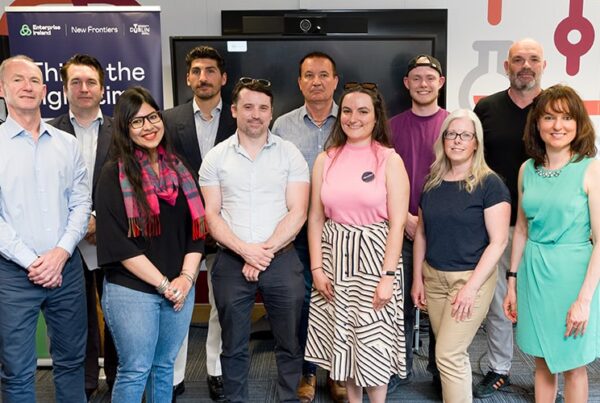
Eight Startup Founders Graduate From Phase 2 Of New Frontiers At TU Dublin
10 Ambitious Founders Celebrated At The New Frontiers Waterford Showcase Event
Cork Showcase Event Celebrates The Achievements Of The Latest Phase 2 Cohort

Shane Doherty On Leaving Life Insurance To Build A Hotel Revenue Management System
A Cohort Of Ambitious Entrepreneurs Graduates From New Frontiers In The Midwest