Fiona Finucane spent over two decades at the sharp end of financial regulation, designing the kind of compliance infrastructure that keeps global institutions out of trouble. Now, she’s solving a similar problem for the small financial firms that are facing a significant step up in what compliance requires of them.
Fiona’s career in financial services began in 2001, more by accident than design. “That’s where things led,” she says simply. She joined PFPC (which later rebranded as PNC) and found that she loved fund administration. When the investment business was acquired by Bank of New York Mellon, she went with it and, at 28, was one of the youngest directors in the bank’s history and the first woman to hold that role in Europe.
From BNY, she was headhunted by Deutsche Bank. After a hybrid role between Dublin and California that involved auditing and then improving quality control, she made a sideways move into regulatory solutions that would involve less time away from family. “It sounds boring, but I loved it.” She designed Deutsche’s own regulatory solutions from the ground up, building a product the bank could rely on as compliance went from being a checkbox to a liability. When Deutsche’s fund services arm was sold to Apex Fund Services, she made the move and spent five years there.
In October 2023, Fiona was made redundant and found herself at the kind of career crossroads that a strong CV doesn’t automatically solve. She was too senior for the roles available in Ireland and the only real next steps were abroad. Not wanting to uproot her family – and dealing with some health matters that needed attention – she set up a facial therapy business from home while she figured out what came next.
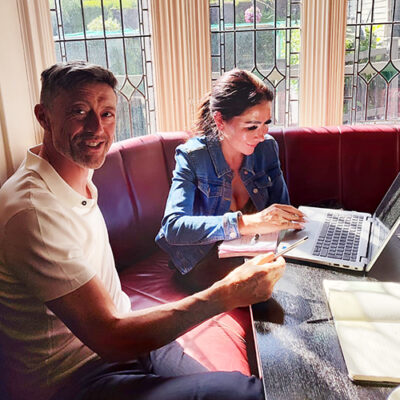
Fiona Finucane and co-founder Richard Metcalfe
During a conversation with Richard Metcalfe, a technologist she had worked with at Deutsche Bank who is now her co-founder and CGO, he asked where Fiona thought the biggest gaps were in the market. She didn’t have to think for long – the regulatory landscape around anti-money laundering (AML) and know your customer (KYC) had been shifting for years, and the direction of travel was clear. Historically, the scrutiny fell on the banks and the large fund administrators. But a significant portion of financial risk moves through smaller firms – accountants, legal advisers, and wealth managers – and regulators had started paying attention.
New enforceable rules around client onboarding and AML controls are landing in 2026 and 2027. The smaller end of the market was, in Fiona’s view, badly exposed and underserved. They decided to explore whether a product could address it. After 150 interviews with people working inside the SMEs they were targeting, a pattern emerged. Data protection concerns, complexity, and the hassle of handing client information to a third party meant that nobody wanted a compliance service. What they wanted was software that was affordable, secure, and straightforward to implement. The enterprise-grade compliance platforms on the market come with enterprise price tags. For a firm of five or ten people facing a regulatory requirement that generates no revenue, they are unaffordable.
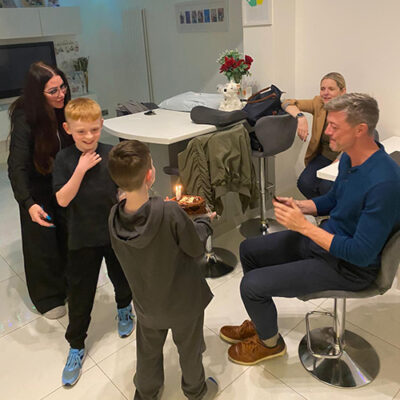
Fiona (left) at a birthday celebration with Richard Metcalfe (CGO) and Rachel Martin (Director)
With more research came another realisation. The majority of firms work with Microsoft products. Their data is already there; building within that ecosystem meant the product could sit inside a company’s own Microsoft tenancy, with no external data transfer and no integration headaches. The audit trail that the new regulations demand would be generated automatically inside tools people were already using. Fiona and Richard built a Power Apps prototype to test the concept. It went down well enough to justify going further.
With a small amount of personal investment, they got to work, including putting a website together. But building a scalable product needed a development team. Through some consultancy work she had taken on during her career break, Fiona had developed a relationship with a development company in India. She showed them the idea, offered equity in lieu of fees, and they agreed to come onboard.
“I have built products from the ground up. I’ve sold them. And they have been hugely successful. But I did it within the corporate environment – meaning I had a marketing department, an IT department… everything was at my fingertips. I just had to pick up the phone or send an email. Now there is no one to phone or email. It’s me. I needed to actually learn these skills myself – while balancing family life and making sure the lights stay on.”
No amount of corporate experience fully prepares you for the role of founder. Backed by her family, Fiona decided to go for it, securing her place on Phase 1 of New Frontiers. “I did wonder what I would learn but honestly, I learned so much. Every day was a school day. There were things you’d never have thought of. There were things you knew but they put a different perspective on it. I would encourage anyone to do it.”
New ventures need research. Not just feedback from people who are already in your corner, but critical insight too. Cold outreach is something that many founders struggle with – either the approach itself, or knowing what to ask, or the fact that they have nothing to offer in return. Fiona used every outreach approach she could think of. She researched people online and attended every in-person event she could, asking to pick people’s brains. The rejection rate was brutal and entirely normal; over time she developed the thick skin it requires.
“You might send 200 emails and only get one response. Celebrate that one victory instead of the emails that got ignored. We all get emails like that, and we ignore them ourselves. When you get that one response, look at their profile. Can you tailor your next search in that area and send out your next 200 requests? Maybe next time you’ll get two responses! You never know who you can get in front of if you ask, and sometimes those contacts might be potential collaborators or even future clients. When you do get to have a conversation, ask them if they can think of anyone else you could talk to, and often they will be happy to put you in touch with someone else.”
The programme also pushed Fiona to think seriously about factors such as threat substitutes, a concern that didn’t exist for her inside a top-tier bank. “Before, I got paid regardless. And I got my pension and healthcare regardless. Now, all of a sudden, it’s a one-way street. You keep putting money in but it’s not going to come back any time soon! On New Frontiers, or when you’re talking to Enterprise Ireland, the question isn’t ‘is the idea good?’, but ‘is it viable?’. ‘Is it defensible?’ If a major player decided to build the same solution tomorrow, how are you protected? They make you think and have a plan, even if you can’t protect your IP.”
Asked if she would do anything differently, Fiona says she would be more realistic about timelines. “When a developer says something will be ready on the first of July, bear in mind that might not be this year. People working for sweat equity have day jobs and lives. Things get derailed. The question I have learned to ask is whether something is a bump or an actual derail. If things get derailed, you need to be able to pivot and not consider that a failure. No matter how easy people make it look, no one had smooth sailing. Be kinder to yourself. I would go back and have that conversation with myself earlier on.”
Having come through all three phases of New Frontiers, Fiona’s advice to other new founders is to network. Who you surround yourself with is key, and you should never miss an opportunity to meet, learn from, and collaborate with others. “When you see a business that’s a bit further ahead of you, it’s natural to think they’re somehow more brilliant than you. But you’re not comparing like with like. Even if they’re in a completely different area, ask yourself ‘what are they doing that I could learn from?’. We’re always swapping ideas or offering tips in the group chat.
“You might think there’s nothing relevant at an event, but if you go, you’ll chat to people and you might come across someone with a crossover. Use your network. My family have never really understood what I do but they are supportive and I ask them for help with all kinds of things. You do have to step out of your comfort zone. You can’t think ‘I’ll just hire a salesperson’ (with what money?!) or ‘I’ll just use AI’ (yes, you along with half the rest of the world!).
“At the beginning, I had the idea, but I didn’t have the resources. I needed to become independently resourceful. Join every accelerator and programme you can. Sit down with your Local Enterprise Office and ask about what supports are out there; they’re nothing but helpful when you reach out, and there’s a lot out there. Network!”
The regulatory deadline is coming. From July 2026, the firms that Finperiti was built for will need to demonstrate they have the controls, the documentation, and the audit trail to satisfy inspectors. Where you used to just explain how your process works, now you have to show real examples. Finperiti sits inside the Microsoft environment, automating KYC and document collection with an evidence trail but without the enterprise-level complexity or price.
Fiona was a participant of the dual-location New Frontiers programme in Dundalk (DkIT) and Dublin (DCU) where our Programme Manager is April McCrave. Learn more about Fiona’s company at finperiti.com.
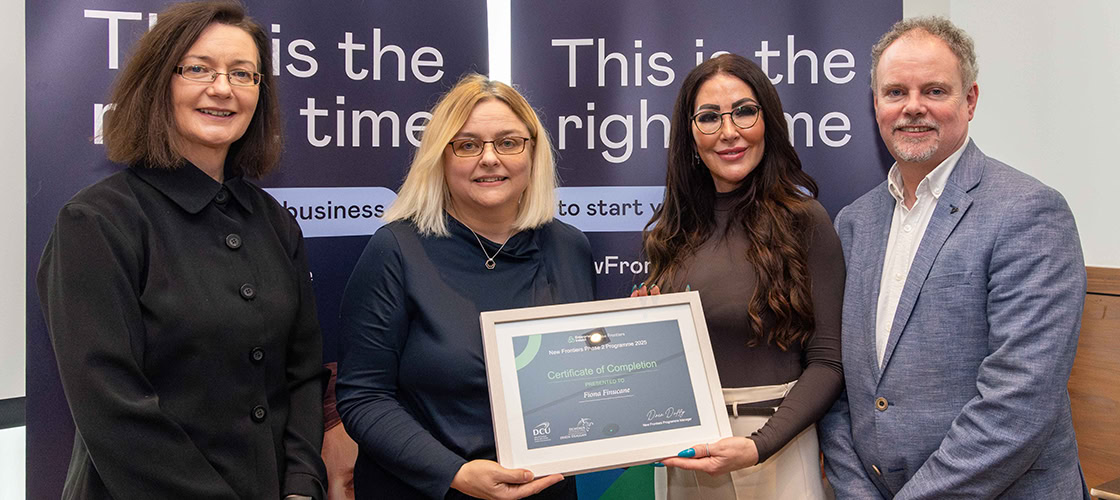
[featured image (l-r): Maria Johnston, Dara Duffy, Fiona Finucane, Garrett Duffy]
About the author
 Scarlet Bierman
 Scarlet Bierman
Scarlet Bierman is a content consultant, commissioned by Enterprise Ireland to fulfil the role of Editor of the New Frontiers website. She is an expert in designing and executing ethical marketing strategies and passionate about helping businesses to develop a quality online presence.
Recent articles

Rekha Jonnala’s Startup, PRIJYM, Is Transforming Lab Ops With A Unified Compliance Platform

Corina Popov Is Making Tax Digital For Sole Traders Across The EU
Eight Startup Founders Graduate From Phase 2 Of New Frontiers At TU Dublin
10 Ambitious Founders Celebrated At The New Frontiers Waterford Showcase Event
Cork Showcase Event Celebrates The Achievements Of The Latest Phase 2 Cohort

Shane Doherty On Leaving Life Insurance To Build A Hotel Revenue Management System
A Cohort Of Ambitious Entrepreneurs Graduates From New Frontiers In The Midwest