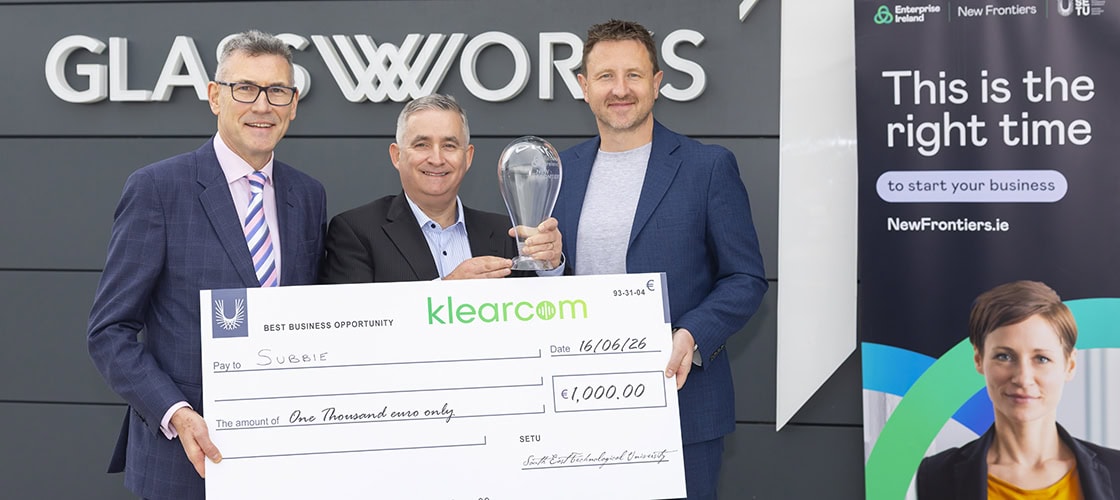
Leo Moore is the founder of Subbie, an AI-based subscription management platform for scaling SaaS companies. It connects to payment and accounting systems such as Stripe, PayPal, and Xero and turns messy subscription data into real-time metrics, including ARR, churn, and LTV. Leo took part in Phase 2 of New Frontiers at SETU Waterford and won the Best Business Opportunity Award at the graduation event in June. We talked to him about the problem, the product, and where AI fits in.
You have a long career in tech. What was the problem you kept seeing?
I’m a software developer by background, with a degree in computer science and an MBA, and worked in data analytics for many years. I sold CRM systems for about 20 years and saw firsthand the move from on-premise software to software as a service. The problem we always had with SaaS was that tracking the metrics can be very complicated.

Leo Moore
It starts off simple, usually with monthly transactions paid by credit card. But before long you have annual contracts, and sometimes multi-year contracts, on top of that. You’re pulling information from Stripe or PayPal and from your accounting system and trying to bring it all together. People tend to do this in spreadsheets – extracting the data, manipulating it, converting it from annual to monthly, and doing the currency conversions.
It’s a lot of work every month to collate that information so you have proper metrics to give your board and your management. And when you do it this way, the data you have is already old. In a larger company with thousands of subscriptions, it can take five or six days to wrangle the data, so you only do the exercise once a month. The usefulness of the data is gone, and you’re looking in the rearview mirror.
That was the genesis of the idea. I realised there had to be a better way to automate this. I have worked a lot with payroll systems, so I have in-depth knowledge of integrating with the back ends of financial systems. That is the technical core of Subbie.
How does Subbie solve all this data complexity?
We’ve created a system that automates the manual effort of extracting the data, manipulating it, and producing those metrics. It takes a lot of experience to know how to handle this kind of data, especially where it’s incomplete or ambiguous – like telling a series of one-off payments apart from a subscription, for example.
By automating, we also make the data available in real time, which means you can see where you stand now. That gives the company a lot of additional benefits. Management can manage performance and correct things in real time. You can segment your data, find where churn is happening, spot growth opportunities, and see where to invest your marketing for the best returns.
Having a clean data platform means you can add an agentic layer to help with internal processes. You couldn’t do that before, because the data was out of date and spread across multiple systems, so you might end up chasing a client for a payment they’d already made. With reliable data, agents can look for potential renewals or churn and offer remediation, such as a customer service intervention or targeted messages and discounts.
As someone building a SaaS business, how do you feel about the suggestion that AI will kill off the need for SaaS products?
In the past, software was only on premise. You had a server in the office, and you had to maintain and update it yourself. When cloud services came along, the question was obviously, ‘Why employ someone to maintain a physical server in the office so you can run software when all you want to do is use the system?’
I have two analogies. The first is bread. Any of us can make bread, and a bread machine makes it easy, but most of us still go to the shop and buy it. Using AI to build your own CRM system is buying the bread machine; the building is cheap, but now you’re the baker. My career is long enough that I’ve had to maintain systems I built 20 years ago. Building something is a one-off; maintaining it can last decades. Rewriting systems also introduces risk, so it is often less risky to maintain existing systems than rewrite them every couple of years. Just ask the banks. You also have to consider the management of the data and, of course, security. Systems are not just the software; it’s the delivery of an operational, stable, and secure solution to a business problem over the long term.
The second analogy is what Rory Sutherland calls the doorman fallacy. You might think you could get AI to replace the doorman until you realise he does a lot more than open the door or take phone calls. It’s the same with SaaS – the product does more than its obvious function. A SaaS company has the benefit of looking across an entire industry and bringing all kinds of learnings into the product, whereas an individual asking AI to build something for their business only has their own ideas and experience.
On the broader ‘SaaSpocalypse’, there’s bound to be pressure on narrow SaaS products, where people feel they can probably do without them now. But not on broader SaaS, because the reality is that most people don’t want to build and manage their own once they realise what’s involved. There was a proliferation of SaaS products with very undifferentiated offerings and an underappreciation of how hard it is to grow a customer base. It’s an easy industry to get into but a very hard one to make a success of. It takes time; being around long enough to keep iterating and improving from experience is important.
What has been the biggest challenge in building the business?
The biggest challenge is engaging with the market. Some developers build in isolation, but it’s vital to talk to as many customers as possible, learn from the market, and take that information to create generalised solutions that solve a problem for many different people. You can’t solve every problem for every person, and some problems aren’t appropriate to fix.
It’s natural at the start to say ‘yes’ to everything, but the risk is that your product isn’t coherent and becomes confusing for customers. So you have to be able to say ‘no’ to some things. For people from a technical background especially, engaging with customers can be the hardest part, but it’s certainly the most rewarding.
What impact did New Frontiers have on the business, and where are you headed now?
The idea for Subbie had been bubbling along for a couple of years, and I worked on it in my spare time. I applied to New Frontiers and was accepted onto Phase 2 at SETU Waterford, which started just before Christmas 2025. The programme team was great, especially the Programme Manager, Dr Eugene Crehan. Their passion for the startup ecosystem is very evident, and they were so helpful and gave so much time and effort.
I really appreciate the opportunity New Frontiers gave me to work on the idea and crystallise the needs of the project. There was a huge difference between the business going in and coming out six months later. You work on the marketing, the business planning, and raising finance, and I found it really useful to have outside people to look in and give feedback.
What we were building changed, too. We started off focused on the metrics problem, but as we went through the programme, we started exploring the value and opportunities that the data collected opened up for our customers.
We’re actively selling in Ireland, the UK, and the US. Expanding in the UK is our objective for 2027; then we will look to other European markets. Our largest segment is companies in the €1 million to €10 million range – big enough to have the problem, but not big enough to have fixed it. We have received funding from LEO Kildare, and we plan to apply for Enterprise Ireland Pre-Seed Start Funding (PSSF) too.
Subbie uses AI, but you’re cautious about what it can do. What advice would you give people about its use?
The key is to understand the limitations of AI. It’s great technology, and it has transformed how we work, but a lot of business is about people – and AI doesn’t know people. You can use it for customer service, but nothing tells a client how little they’re valued like dealing with a bot that doesn’t care whether their problem is solved or not.
Our own platform is a good example. Subbie uses AI to spot growth opportunities and reduce churn, but what keeps the customer is how our client responds, and that’s the human element. Keeping a customer is complicated and messy, and people can handle unusual circumstances in a way AI can’t. Get that part wrong and you lose the customer.
So, learn what AI is good at and what it isn’t before you switch it on. There’s a tendency to think AI can do everything, but when you’re in the tech industry, you forget that most of daily life isn’t about tech.
Leo was a participant of New Frontiers in Waterford (South East Technological University (SETU) – Waterford Campus) where our Programme Manager is Dr Eugene Crehan. Learn more about the company at subbie.ai.
About the author
 Scarlet Bierman
 Scarlet Bierman
 is a content consultant, commissioned by Enterprise Ireland to fulfil the role of Editor of the New Frontiers website. She is an expert in designing and executing ethical marketing strategies and passionate about helping businesses to develop a quality online presence.
Recent articles
Leo Moore’s Startup, Subbie, Turns Messy Subscription Data Into Real-Time Insights
Eleven Founders Graduate From New Frontiers In South Dublin (IADT & NovaUCD)

Rekha Jonnala’s Startup, PRIJYM, Is Transforming Lab Ops With A Unified Compliance Platform

Corina Popov Is Making Tax Digital For Sole Traders Across The EU
Eight Startup Founders Graduate From Phase 2 Of New Frontiers At TU Dublin
Ten Ambitious Founders Celebrated At The New Frontiers Waterford Showcase Event
Cork Showcase Event Celebrates The Achievements Of The Latest Phase 2 Cohort